
How Do We Talk About Dead Wrestlers?
Wrestling is both real and fake, so how do we talk about very real bad people in that context?

In 2007, I was working as a waiter at a Ruby Tuesday in Fort Payne, AL, which necessitated a pretty annoying half-hour drive. I would routinely find myself in town early, so I would stop somewhere and grab food. On this particular sunny afternoon before my shift, I found myself sitting in a McDonald’s and watching the news.
I didn’t have cable or home Internet at that point in my life, and my car radio was busted, so I listened to CDs on a boombox in my passenger seat. Needless to say, I didn’t get a lot of news throughout the day. So it was in this McDonald’s that I learned about the death of WWE Superstar Chris Benoit at 40 years old.
I had been aware of Benoit, but at the time, my interest in wrestling had died down. I shrugged off the story and didn’t think much of it, but the universe had other ideas. It came to light quickly that Benoit’s death was not a tragic accident, but a violent murder-suicide, in which he had murdered his wife, Nancy, and their seven-year-old son, Daniel. WWE, foot firmly in mouth after an emotional three-hour tribute, quickly brushed the ordeal under the rug, removing his merchandise from stores and erasing Benoit’s name from the company’s history. Lifelong fans of the wrestler, who had been popular since the early ’90s in a variety of wrestling promotions, quickly turned on him in disgust. Chris Benoit went from celebrated wrestler to persona non grata overnight.
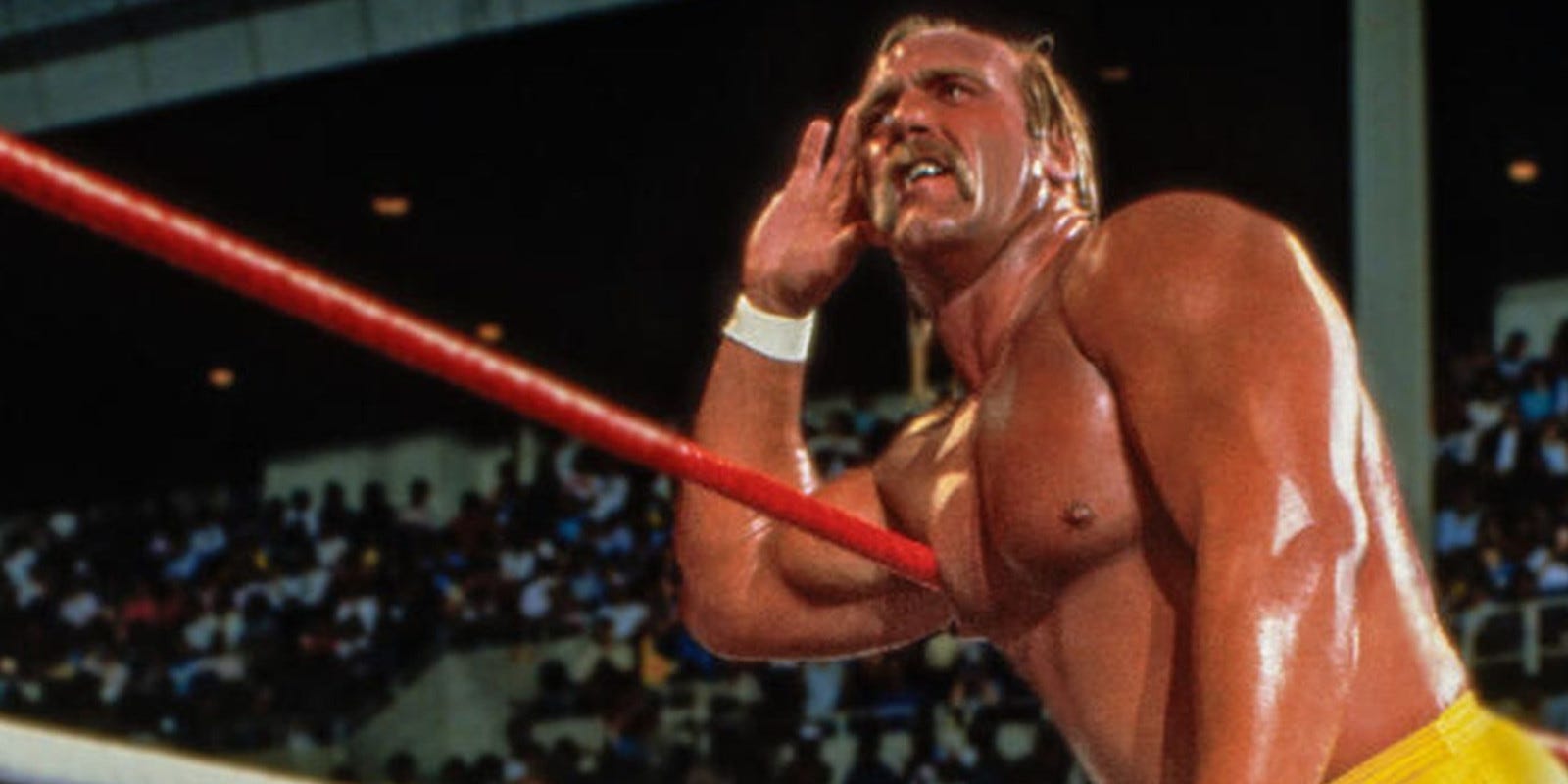
It’s no coincidence that I find myself thinking back to that afternoon today. Just a few hours before I started writing this, news broke that Hulk Hogan, the indomitable force who served as the face of pro wrestling for most of my life, had died as a result of a cardiac arrest. He was 71 years old; young by the standards of most everyone we know, but positively ancient compared to his wrestling brethren, who routinely die young.
Tributes are pouring in from celebrities and wrestlers alike, but fans are left at odds with the controversial reality of the man himself. With the death of Hogan comes an opportunity to ask ourselves: how are we supposed to talk about dead wrestlers and our parasocial relationship with them?
A Startlingly Flawed Superhero
Hulk Hogan began wrestling in 1979 and made his debut in the WWE (then known as the WWF) in 1983. By January 1984, he’d already won his first world title, kicking off Hulkamania and a professional wrestling boom that changed the world. Hogan would wrestle with the WWF for the better part of a decade, leaving the company for Hollywood in 1993. He wouldn’t be gone for long, signing with rival promotion WCW the following year and redefining wrestling again in the nWo as “Hollywood” Hogan.
The first time I saw Hogan wrestle would have been my high school years, by which point he had returned to the WWE following WCW’s buyout. I remember vividly the night he came back out as Hulk Hogan for the first time in years, sporting colorful boas and gleefully shredding air guitar to his entrance music, shedding the nWo persona for a crowd that was so electric they could power a small country. It was a genuinely exciting time to be a wrestling fan, and something that left a huge impression on me as I watched the show on a small TV with the volume turned down so no one in the house would realize I was still awake.
But it’s gotten harder to picture that Hogan over the years. A slew of real-life personal incidents exposed a version of Hogan that was always there. As wrestling became less about kayfabe and the Internet made reporting every iota of data that much easier, his real demeanor became public knowledge.
Sure, there were controversies beforehand. Hogan once choked out comedian Richard Belzer on television, an incident that left Belzer with a head injury and the grounds for a lawsuit. In the late ’80s, Hogan reportedly informed WWE owner Vince McMahon about a planned attempt to unionize among WWE’s wrestlers, resulting in the termination of Jesse “The Body” Ventura. In 1994, Hogan testified in the infamous US vs Vince McMahon steroid trial, admitting to using steroids while employed by WWE. While this revelation was damaging to his public image, he also arguably saved the WWE when he admitted McMahon had not sold him the steroids or ordered him to use them.
The real controversies came in the 2000s. 2012 saw the release of a sex tape recorded without Hogan’s knowledge. It was leaked by entertainment blog Gawker. While the creation and release of the tape without his knowledge or consent is an undeniable violation of Hogan’s privacy, the resulting lawsuit had a huge ripple effect on media. Hogan’s lawsuit was powered by a legal fund put together specifically to target Gawker, resulting in a trial that nuked the website from orbit, ending its day-to-day operations. The legacy of the trial is still mixed; most have praised it for redefining how we view celebrity and the right to privacy, while some journalists have raised concerns about the precedents it set being used to silence outlets from publishing newsworthy topics.
But the trial wouldn’t stop haunting Hogan. Court documents were leaked a few years later and reported in a joint effort by Radar Online and the National Enquirer. The transcripts were the public’s first exposure to a shocking side of Hogan that had never been seen before, as the legendary wrestler admitted to being “racist to a point” in a vile, slur-filled rant.
From here, controversy continued to follow Hogan. Stories began to drip-feed from other wrestlers about the horrors of working with him, refusing to put over other wrestlers or lobbying to win matches he had previously agreed to lose. Fans began to note how many of his larger-than-life parables seemed to be embellished, if not outright lies (unless, of course, you believe Hulk Hogan really was almost the bassist for Metallica). Most recently, fans balked at Hogan becoming a vocal supporter of the Republican Party and President Donald Trump. His appearance at the 2024 Republican Convention left such a sour taste in the mouths of fans that he was loudly booed when he appeared on Raw‘s much-hyped Netflix debut to promote his beer, Real American Beer.
(At the time of his death, his beer brand was also under scrutiny, as a company alleged the brand concept was stolen.)
Can You Deny a Legacy?
But booed or not, Hogan was at that Netflix debut for a reason. He won his first world title just a few months before I was born, so there’s not a point in my life where Hulk Hogan was not an existing cultural icon. I was born into a world where Hulk Hogan was already the biggest wrestling champion in existence. He was so formative a figure that I knew who he was, even though I had never watched a WWE program in my life. By the time I was old enough to care about watching wrestling, Hogan was long gone, headed to Hollywood.
Hogan made his big-screen debut in Rocky III just before his WWE debut. While he had some success during his WWE run with No Holds Barred, his post-WWE career faltered. Suburban Commando and Mr. Nanny flopped at the box office, making $8 million on an $11 million budget and $4.3 million on a $10 million budget, respectively. His later films, Santa With Muscles and the 3 Ninjas sequel High Noon at Mega Mountain, did markedly worse, making less than $400,000 each.
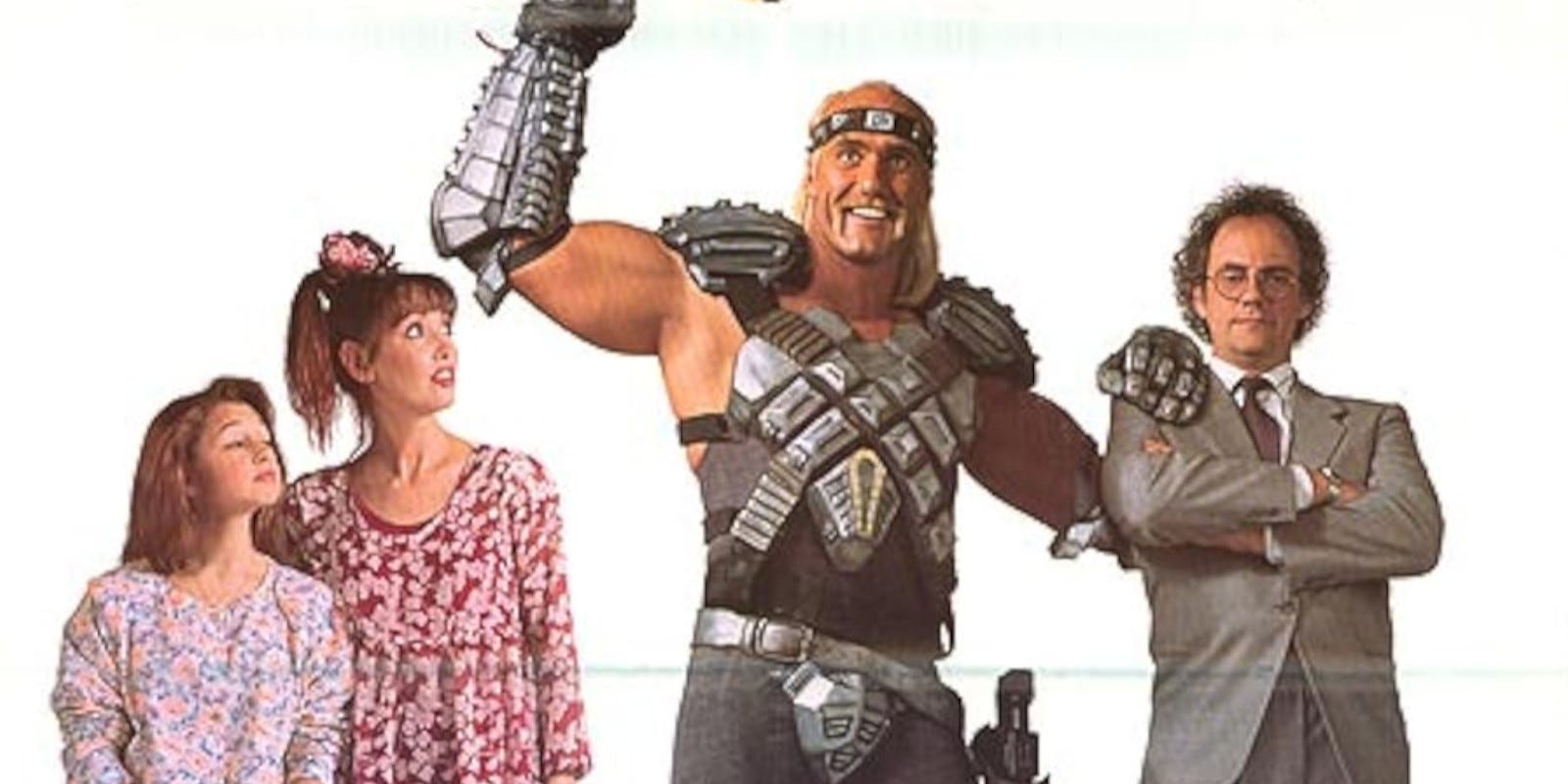
But those films are all remembered, despite their poor performance. If you have a few wrestling friends, at least one of them has crowed about No Holds Barred or Santa With Muscles to you, perhaps even unironically. And I am not afraid to admit that as a kid, I got a kick out of Suburban Commando and, yes, even Mr. Nanny.
Outside of that was the larger-than-life figure. Hogan was a reality TV star, a game show host, an icon. As a kid, he was a living cartoon character — literally, if you grew up with Hulk Hogan’s Rock ‘n’ Wrestling, where Hulk (voiced by Brad Garrett) and his pals battled a swath of wrestling’s greatest villains. He also had his own chain of fast food pasta stores, a record, and more. Toys, dolls, shirts, hats, fanny packs, posters, cups, backpacks — if Hulk Hogan could be put on it, somebody sold it, and every kid wanted it.
But he was and still is the face of professional wrestling. Hulkamania made pro wrestling the biggest thing in the world, and turned both Hogan and WWE into cultural icons. Kids didn’t know about the behind-the-scenes drama; they just cared about the Hulkster, a noble and stoic figure who just wanted to have a good match and be there for the little Hulkamaniacs.
Hogan came and went from WWE five times in all, but his return in the early ’00s was arguably his most important. In rival promotion WCW, Hogan had established the heel faction New World Order, or nWo, and shocked the world by becoming a villain. The nWo was so huge that we’re still dealing with the fallout today, as every promotion in the world tries to recreate that magic. Bullet Club, Aces & 8s, The Bloodline, and John Cena’s most recent shocking heel turn are all wrestling moments that share DNA with what Hogan did in WCW.
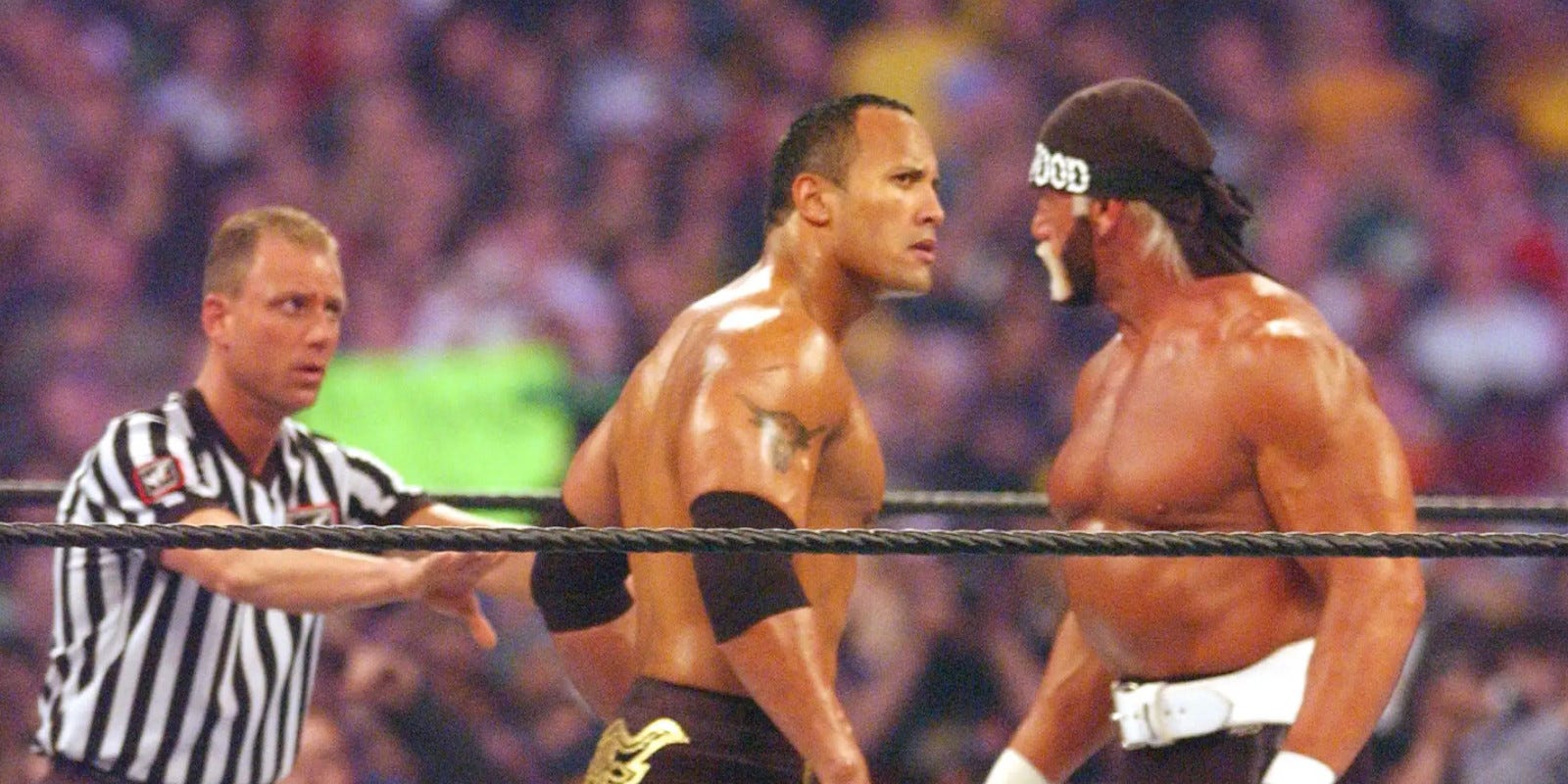
But when Hogan came back to WWE in 2002, nobody could have guessed he’d be having the most important match in the industry during the second half of his career. Facing off against The Rock at WrestleMania 18, both men put on a masterclass in how wrestlers can work a crowd. After a decade of booing Hogan as WCW’s top heel, fans were hungry to cheer for Hulk Hogan again, so they flipped their dynamic mid-match to give them what they wanted. Both men were firing on all cylinders for the match, and the crowd was eating out of the palms of their hands.
Hogan left WWE a year or so after that match. The controversies began to wear down his public image, and age hit the Hulkster hard. Hogan tries to keep wrestling a little longer than he probably should have, and decades of injuries start catching up. The fan ire grows as his personal life becomes a talking point, all while his shoulders get a little rounder and his walking becomes a little stiffer. Wrestlers have always aged hard. The damage seems to accumulate until it hits them all at once in the twilight of their careers, and their bodies succumb to the strain of years of matches. For fans, Hogan fell apart in real-time right before their eyes.
Now we’re at a point where we have to reckon with that reality. For many of the people faced with the legacy of Hulk Hogan, it’s the death of an icon. They wanted those toys, they cheered in those matches, they grew up with Rock ‘n Wrestling, and they loved Hogan Knows Best. But most importantly, they loved the Real American, who told them they could be as strong and pure as he if they just said their prayers and took their vitamins. How can someone who loved Hogan as a child possibly look at him as anything other than a hero?
Controversy + Time = ???
In the aftermath of the Chris Benoit murder-suicide, most journalists were quick to dismiss it as the result of “roid rage”. But those familiar with CTE, including wrestler-turned-neuroscientist Christopher Nowinski, who worked in WWE alongside Benoit from 2002-2003, tried to speak out about the physical toll of the sport and the role it may have played. Benoit worked a notoriously high-impact style and was known for taking chair shots to the back of the head and using an unprotected flying headbutt as a finisher. In the end, it was discovered that Benoit’s brain showed so much damage that it resembled that of an 85-year-old Alzheimer’s patient.
Brain damage doesn’t excuse Benoit’s actions, but it could explain them. Other explanations, ranging from alcohol abuse to a mental health crisis, have been offered. In recent years, Benoit’s legacy has not been restored, but the hatred toward him has softened into a kind of bitter reckoning. For most, his legacy is not one to celebrate, but his cautionary tale is one to remember. I have often found myself thinking back to those months after the tragedy, and how eager we were to pretend he never existed. When WWE erased Benoit from its history, everyone believed that was the right decision. Was it, though? Or did we deny ourselves the opportunity not just to discuss what happened to Chris Benoit, but how to prevent it from happening again?
You’re going to see the opposite happen over the next few days with Hulk Hogan, as interested parties will want to rehabilitate his image so that it can be marketed. You are about to witness a rewriting of history the likes of which you’ve probably never seen before, and almost certainly it will be led and supported by the WWE. Over the next few weeks to months, you’re going to see Hulk Hogan recontextualized through rose-tinted glasses.
The problem is the precedent this sets. Benoit and Hogan are far from the first wrestlers to be mired in controversy, and you don’t even have to dig deep to find more. Wrestling has always been a problematic industry at odds with its own existence, caught in the crossfire between fond memories of childhood and the grim reality of the men and women who perform in it. Unfortunately, we no longer have the luxury of pretending it’s a thing to handwave.
It’s fine to still love the Hulk Hogan you saw bodyslam Andre, or lead the nWo, or bicker with his family on reality TV. But it’s important to also break the parasocial cycle so we can openly discuss the harm he did and could have done with his platform as an openly racist public figure and supporter of political agendas that actively harmed at-risk communities. Hulk Hogan, the wrestler, was a larger-than-life figure who countless children looked up to, but Hulk Hogan, the person, normalized racial stereotypes and harmful beliefs in a way that was damning for millions.
It’s not easy to reckon with this, especially as fans and celebrities alike sing the praises of a fan-favorite in the moments after his death. However, in order for us to truly grow into a society where we can have superheroes like Hulk Hogan who don’t have dark sides, we also have to admit that our heroes, no matter how larger-than-life they seem, are also terrifyingly human. And just like any other human, we must be able to hold them accountable for their mistakes just as quickly as we praise them for their talents.
The post How Do We Talk About Dead Wrestlers? appeared first on Homeworld.